Category | Quality Management
Last Updated On 28/05/2026
Most organizations don’t struggle because people work slowly — they struggle because processes create delays, rework, and hidden waste. That’s exactly where What is Lean Six Sigma becomes important. It isn’t just another management term; it’s a practical way to fix inefficiency using data and structured improvement methods.
This article explains how Lean and Six Sigma work together, where the methodology came from, and how teams use it to improve quality, speed, and operational performance in real environments.
TL;DR – Lean Six Sigma in Simple Terms
Area |
Summary |
|---|---|
Lean |
Removes waste and improves workflow speed |
Six Sigma |
Reduces defects and process variation |
Combined Goal |
Faster, consistent, high-quality outcomes |
Core Method |
DMAIC improvement framework |
Key Benefit |
Measurable process improvement |
So, What is Lean Six Sigma?
It is a combined improvement approach that integrates Lean principles (waste reduction) with Six Sigma techniques (variation reduction). Together, they help organizations improve speed, quality, and operational cost efficiency.
Organizations apply Lean and Six Sigma Methodologies to:
Unlike traditional improvement efforts based on assumptions, Lean Six Sigma focuses on measurable business outcomes supported by data.
The goal is simple: deliver better results using smarter processes.
To understand What is Lean Six Sigma, it helps to look at where the two approaches started.
Lean thinking emerged from the Toyota Production System. Its purpose was improving workflow efficiency by removing activities that do not add customer value.
Lean identifies three major problems:
Six Sigma was developed at Motorola to reduce defects using statistical analysis and structured problem-solving.
Its quality benchmark aims for:
Modern organizations realized both approaches solved different parts of the same problem.
Together, Six Sigma and Lean Methodologies create faster and more predictable operations.
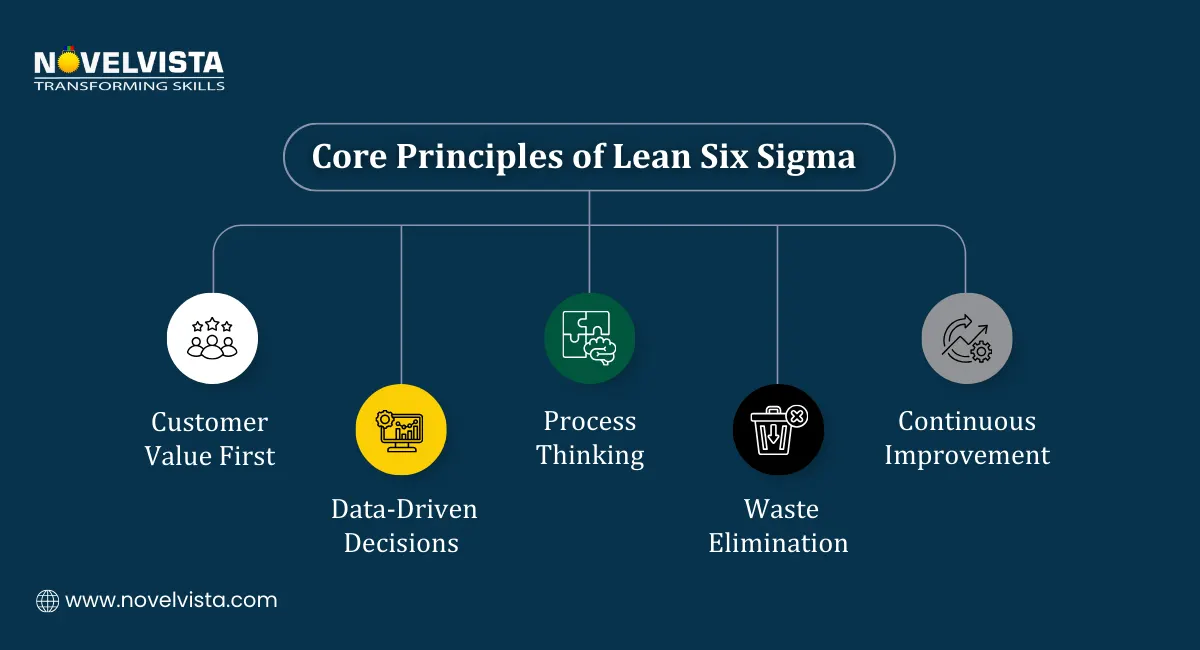
Successful Lean Six Sigma initiatives follow a shared set of principles.
Every improvement starts by understanding what customers truly value.
Problems are validated using measurements, not opinions.
Instead of blaming individuals, teams analyze workflows and systems.
Activities that do not create value are identified and removed.
Improvement becomes an ongoing habit rather than a one-time project.
These principles help organizations apply Lean and Six Sigma Methodologies consistently across departments.
Every project begins by mapping processes and identifying where delays, errors, or unnecessary steps occur.
You may also hear the term Lean Sigma Six. It refers to the same integrated framework.
So again, What is Lean Six Sigma in practical terms? It is the combination of efficiency and precision.
When combined, Six Sigma and Lean Methodologies deliver:
This hybrid model works equally well in manufacturing, healthcare, IT services, and business operations.
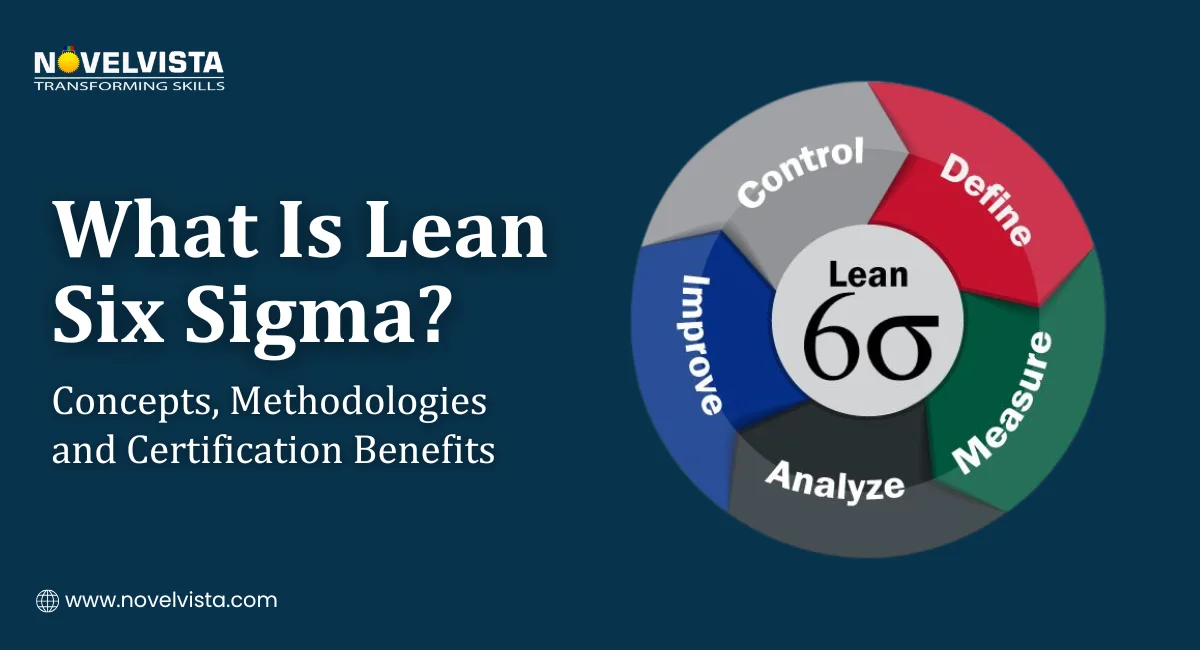
The backbone of What is Lean Six Sigma implementation is the DMAIC framework.
DMAIC provides a structured path for solving problems permanently rather than temporarily.
Define
Identify the problem, goals, and customer expectations.
Measure
Collect data to understand current performance levels.
Analyze
Find root causes using analytical tools and process insights.
Improve
Design and implement solutions that address root causes.
Control
Maintain improvements using monitoring, standards, and documentation.
DMAIC ensures improvements are:
Measurable
Repeatable
Sustainable
In project reviews we assess, teams that strictly follow all five DMAIC phases show significantly higher sustainability rates compared to those skipping structured control mechanisms.
Discover practical tools for real work situations
Learn from real-world examples that simplify complex methods
Gain insights to confidently lead process improvements
Understanding What is Lean Six Sigma becomes easier when you see the tools teams actually use during improvement projects. These tools help visualize problems, identify causes, and sustain improvements over time.
Here are some of the most commonly used techniques within Six Sigma and Lean Methodologies:
Value Stream Mapping
A visual diagram that shows how work moves through a process from start to finish. It helps teams identify delays, bottlenecks, and non-value activities that slow delivery.
5S Framework
A workplace organization method built around five steps:
Sort
Set in order
Shine
Standardize
Sustain
It creates structured and efficient work environments.
Pareto Charts
Based on the 80/20 rule, Pareto analysis helps teams focus on the few causes creating most problems instead of trying to fix everything at once.
Control Charts
Used to monitor process stability over time. These charts show whether variation is normal or caused by deeper issues requiring investigation.
5 Whys Analysis
A simple but powerful technique where teams repeatedly ask “why” until the root cause of a problem becomes clear.
Kaizen
Encourages continuous small improvements instead of large disruptive changes. Over time, incremental improvements produce significant operational gains.
Poka-Yoke (Mistake Proofing)
Designing processes so errors become difficult or impossible to make. Examples include automated validations or system safeguards.
These tools allow Lean and Six Sigma Methodologies to move beyond theory into practical daily improvements.
Many professionals exploring process improvement eventually ask: What is Lean Six Sigma Certification?
It is a structured credential system that validates a professional’s ability to apply Lean Six Sigma methods in real business environments.
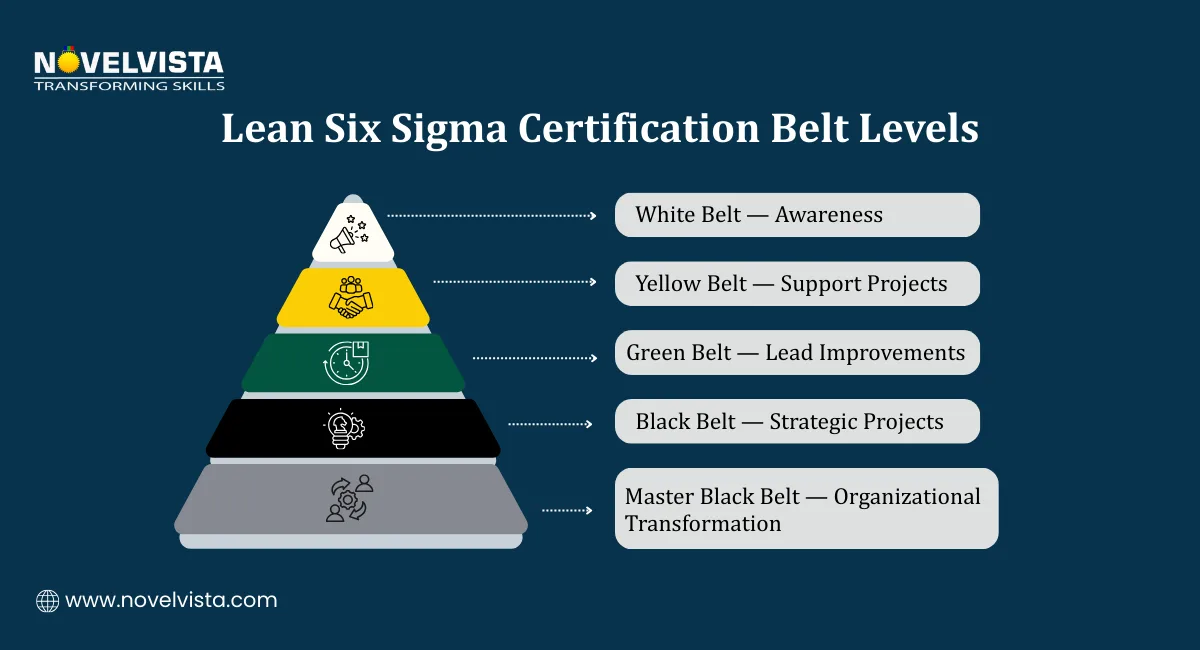
Each certification level represents increasing responsibility and expertise.
White Belt
Basic awareness of Lean Six Sigma concepts
Supports improvement initiatives
Ideal for beginners
Yellow Belt
Participates in projects
Assists with data collection and process mapping
Understands improvement fundamentals
Green Belt
Leads smaller improvement projects
Uses statistical tools and DMAIC methodology
Often works alongside daily operational roles
Black Belt
Manages complex cross-functional projects
Coaches Green Belts
Drives measurable organizational improvements
Master Black Belt
Guides enterprise-level improvement strategy
Mentors teams and defines governance practices
Understanding What is Lean Six Sigma Certification helps professionals choose the right learning path based on career goals and experience level. In certification cohorts over the past year, more than 65% of Green Belt participants completed at least one live improvement project within three months of training.
The value of Lean Six Sigma goes beyond theory. The real impact appears when organizations apply improvements consistently.
For Individuals
Lean Six Sigma Certification Benefits include:
Strong problem-solving credibility across industries
Ability to lead improvement initiatives confidently
Better understanding of data-driven decision making
Improved career opportunities in operations, IT, healthcare, and consulting roles
Professionals gain structured thinking skills that apply to almost any business environment.
For Organizations
Organizations adopting Six Sigma and Lean Methodologies experience:
Reduced operational inefficiencies
Better process predictability
Improved customer experience
Stronger collaboration between departments
The biggest advantage is consistency. Teams stop solving the same problems repeatedly and start preventing them altogether.
These Lean Six Sigma Certification Benefits make the methodology valuable for both personal growth and organizational performance.
Some methodologies fade over time. Lean Six Sigma continues evolving because it adapts to modern work environments.
Today, organizations combine Lean Six Sigma with:
Agile delivery models
DevOps workflows
Automation and analytics platforms
AI-supported decision systems
The reason is simple: businesses still face the same core challenges — delays, inefficiencies, and inconsistent outcomes.
Understanding What is Lean Six Sigma helps teams address these challenges using structured improvement rather than trial and error.
Industries actively applying Lean Six Sigma include:
Manufacturing and supply chain
Healthcare operations
IT service management
Banking and financial services
Retail and customer operations
In cross-industry advisory engagements, we observe Lean Six Sigma integrating smoothly with Agile and ITSM frameworks when governance roles and project charters are clearly defined.
At its core, What is Lean Six Sigma represents a disciplined way to improve processes using data, structure, and continuous learning.
If you want to start applying it immediately:
Begin mapping one existing workflow.
Identify delays or repeated issues.
Use simple tools like the 5 Whys or Pareto analysis.
Apply DMAIC thinking to solve problems step by step.
Professionals interested in deeper expertise often begin with:
Yellow Belt for foundational understanding
Green Belt for leading improvement projects
Learning gradually helps build confidence while delivering measurable results.
Understanding What is Lean Six Sigma changes how organizations approach problems. Instead of reacting to defects or delays, teams learn to analyze causes, improve systems, and sustain results.
By combining efficiency from Lean with precision from Six Sigma, organizations create processes that are faster, more reliable, and easier to manage. Over time, improvement stops being a project and becomes part of everyday work driving consistent performance and long-term growth.
From recent enterprise training programs, over 70% of participants reported improved cross-functional collaboration after applying standardized DMAIC documentation and stakeholder review checkpoints.

Next Step: Build Real Process Improvement Expertise
If you’re ready to move from understanding concepts to leading real improvement projects, NovelVista’s Lean Six Sigma Green Belt + Black Belt Combo Certification helps you build practical skills step by step. The program focuses on DMAIC application, real-world case studies, and hands-on problem solving so you can confidently drive measurable business improvements and advance into high-impact operational and leadership roles.
Author Details

Course Related To This blog
Six Sigma Webinar
Lean Six Sigma Green Belt + Black Belt Combo
Lean Six Sigma Black Belt
Lean Six Sigma Green Belt
Lean Six Sigma Yellow Belt
Confused About Certification?
Get Free Consultation Call
Stay ahead of the curve by tapping into the latest emerging trends and transforming your subscription into a powerful resource. Maximize every feature, unlock exclusive benefits, and ensure you're always one step ahead in your journey to success.